



Adaptive Chess Classes for Students with ADHD or Autism
In-person adaptive chess classes for neurodivergent students ages 6+ in NYC and Greenwich. Adaptive Group lessons offer a small, structured class of 2–6 students. Adaptive Private lessons are built around one student.
Start free: meet with us for a parent evaluation. If the program may fit, we recommend a paid Group or Private trial.
Who Adaptive Chess Classes Are Designed For
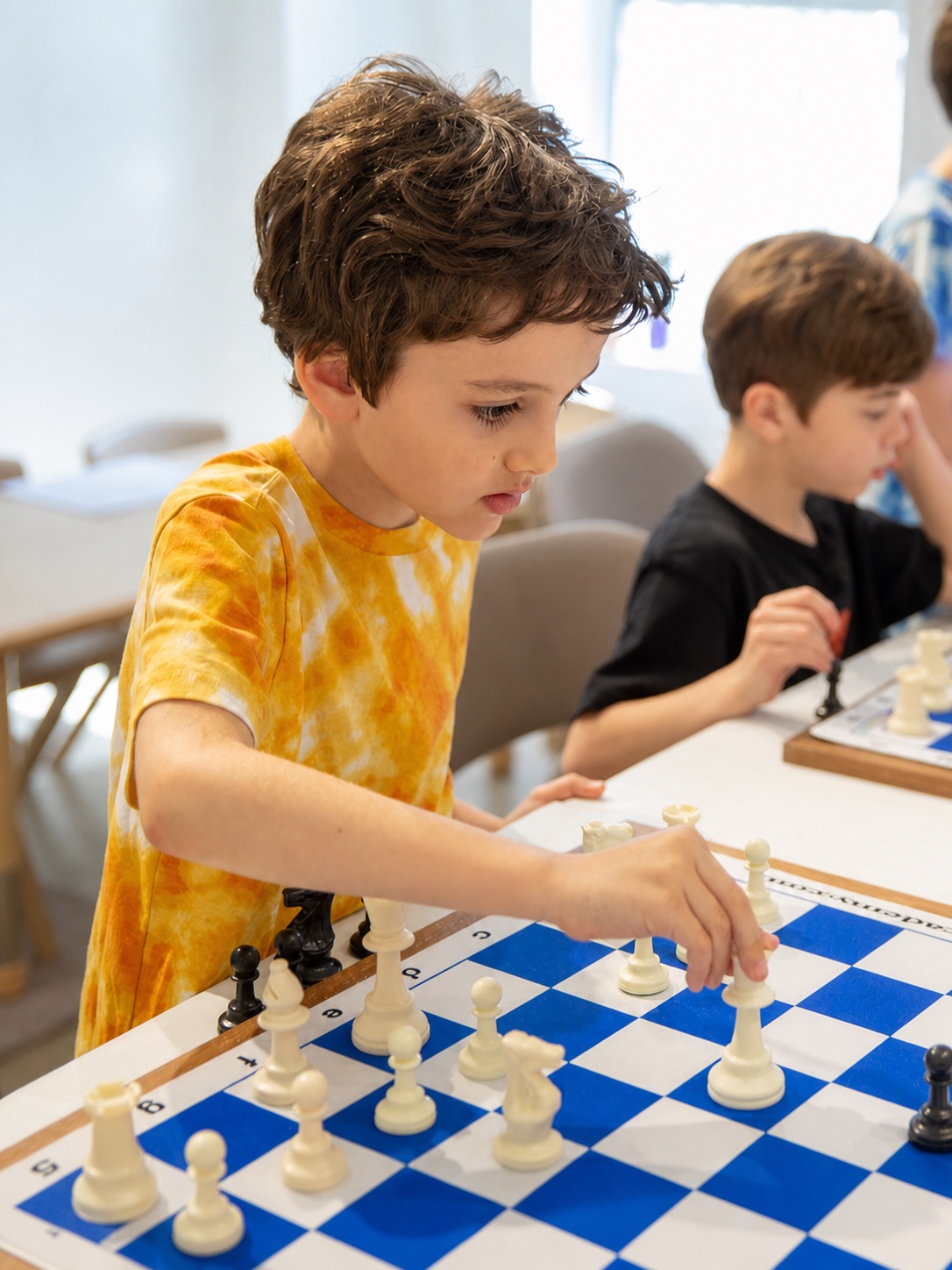
A student may love puzzles and strategy but lose the thread when instructions move too quickly, the room feels busy, or one mistake becomes a hard moment. Adaptive Chess changes how the lesson is delivered so the student has a clearer path back into the game.
When directions move too fast
The coach demonstrates one idea at a time, uses the board as a visual guide, and checks understanding before adding the next step.
When the room feels too busy
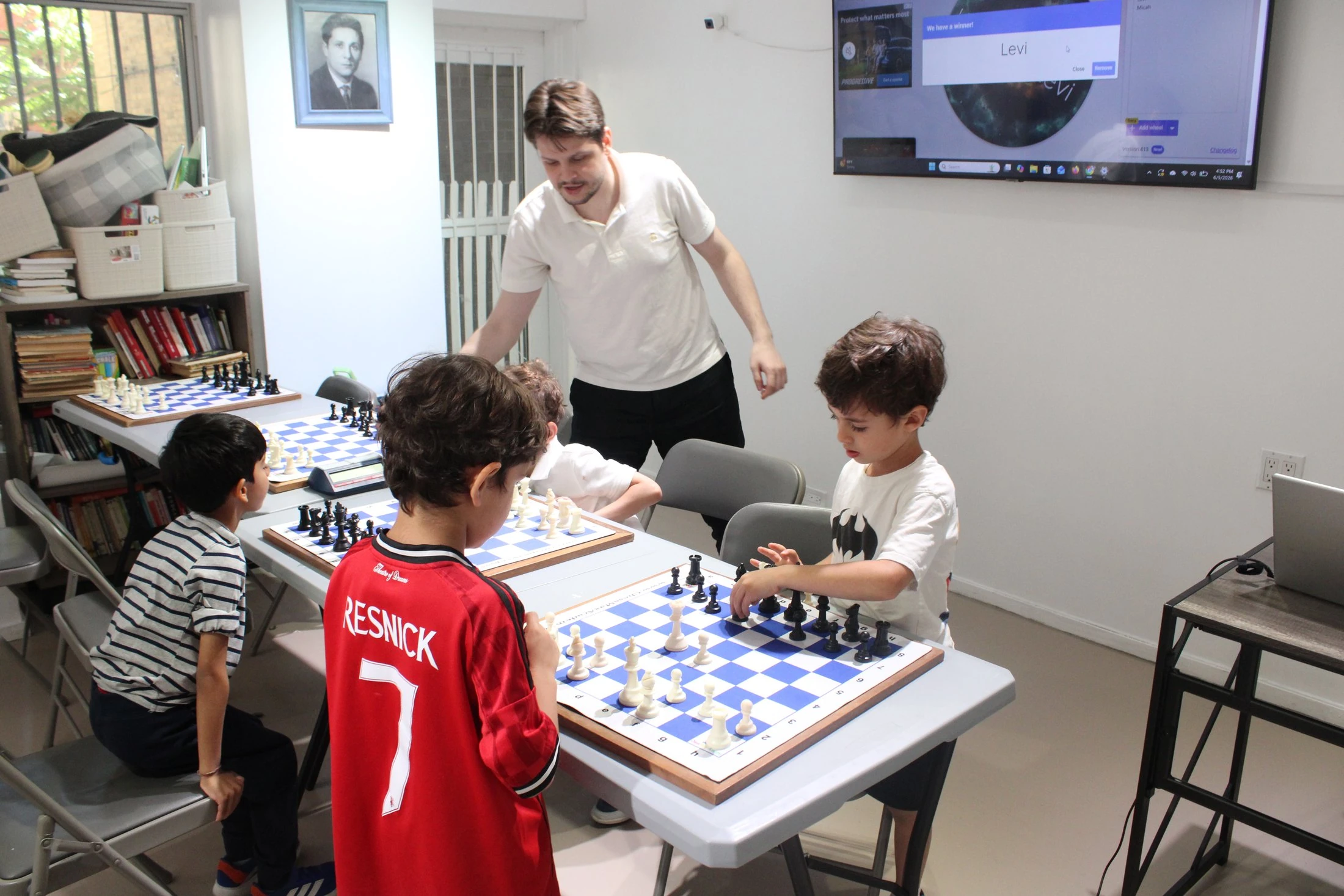
Groups stay at 2–6 students. Clear routines, planned transitions, and more individual attention make it easier to stay connected.
When a mistake becomes a hard moment
Coaches respond calmly, offer a brief reset when needed, and help the student return to the position without shame or pressure.
How Adaptive Chess Lessons Support Attention and Learning
Every move creates a concrete problem, a visible choice, and immediate feedback. Focus, pausing, planning, and recovering after mistakes become part of the game itself.
Focus in short, meaningful cycles
Look at the board, find the problem, choose a move, and see what changes. Each turn offers a fresh and manageable reason to pay attention.
Practice the pause before acting
Students learn a repeatable board routine—scan for checks, captures, and threats—before touching a piece.
Build planning and working-memory habits
Students compare choices, recognize patterns, hold a position in mind, and work through a plan one move at a time.
Regroup after a mistake
Losing a piece does not end the game. Students look again, adjust the plan, and continue with calm coach support.
What Research Says About Chess and ADHD
Parents do not need a wall of statistics. They need to know whether chess can hold a student’s interest, create repeated practice with planning and self-checking, and provide a constructive way to recover from mistakes. Two chess-specific ADHD studies are relevant; both are promising in narrow ways and limited in important ways.
Parents reported improvements after an 11-week chess program
In an uncontrolled 11-week study, 44 children and adolescents ages 6–17 with ADHD enrolled in weekly chess training. Parent-rated inattention and hyperactivity/impulsivity scores improved from before to after the program. The study did not test Chess Max classes.
Important limit: there was no control group, and the outcomes were reported by parents. The study cannot prove that chess caused the change.
Blasco-Fontecilla et al. (2016) — prospective open-label ADHD chess studyA randomized study found some improvements—but not across all measures
A later trial randomized 104 clinically stable participants ages 12–22 to therapeutic chess, a chess-based serious video game, or a control group. It did not find clear improvement on the primary global executive-function outcome, but reported selected changes in emotional control, emotional regulation, and inattention in the Therapeutic Chess group.
Important limit: participants were clinically stable, mostly medicated adolescents and young adults using an electronic therapeutic-chess program. This is not direct evidence for Chess Max classes.
Rodrigo-Yanguas et al. (2023) — randomized therapeutic-chess trialThe right fit matters: the student should enjoy chess
The pilot paper itself cautions that chess is unlikely to help a student who does not enjoy playing. That is why Chess Max starts with a parent conversation and a paid trial before placement.
Chess Max provides educational chess instruction, not therapy or medical treatment, and does not diagnose students. The program is not a substitute for clinical or school-based services. The question is whether this student engages with the lesson, learns chess, and wants to return to the board.
Book a Free EvaluationWhat the evidence supports: offering an engaging, structured chess experience and evaluating the student’s actual response. What it does not support: promising that chess will treat ADHD or autism, or that every student will benefit in the same way.
How Adaptive Chess Lessons Are Structured for Neurodivergent Students
Adaptive Chess combines real chess instruction with a predictable lesson structure, flexible pacing, built-in learning supports, and placement before enrollment. The recommended format is selected after a free evaluation and a paid trial.
Student-centered structure
Clear communication, predictable structure, flexible pacing, sensory awareness, and respectful support.
Preparation before assignment
Chess Max considers the student’s level, goals, learning preferences, schedule, and available instructional format.
Support built into instruction
A visible routine, mini-games, hands-on practice, reset options, and challenge matched to the student.
Thoughtful placement and feedback
Evaluation before trial, the recommended starting format, and clear educational feedback for the family.
Adaptive Group Chess Lessons in NYC and Greenwich
Adaptive Group is a small-group chess class for students with ADHD, autism, anxiety, sensory needs, or related learning differences who enjoy learning with peers and benefit from a calmer pace and clearer structure.
Two to six students learn real chess through visual demonstrations, short teaching blocks, puzzles, mini-games, guided play, and individualized coach feedback. Students are grouped thoughtfully by age, chess level, and learning fit. Group placement still depends on the paid trial, availability, and written offer. Families can also explore standard group chess lessons.
Planned locations: Upper West Side, East 78th Street, Lexington Avenue at 93rd Street, and Greenwich, Connecticut. Final schedule, tuition, and enrollment terms are confirmed in the written offer after the recommended trial.
Read the Adaptive Chess Registration AgreementAdaptive Private Chess Lessons in NYC and Greenwich
Adaptive Private is one-to-one chess instruction for a student who needs the coach’s full attention, a highly flexible pace, or an individual path through the curriculum.
The coach can adjust language, board setup, activity length, and chess difficulty in the moment. Private lessons can be a long-term format, a faster path for a strong chess interest, or a bridge toward a future Adaptive Group. Group placement is not guaranteed. Families can also compare standard private chess lessons.
Book a Free EvaluationOne coach, one student
Full attention to engagement, understanding, pacing, frustration, and chess progress.
An individual chess plan
Lessons begin at the student’s current level and build the next tactics, calculation, planning, and game skills.
Flexible lesson design
The coach can change the explanation, activity, board position, or challenge while keeping the lesson purposeful.
A format that can grow
Continue privately, prepare for a group, or combine formats when the student is ready. Group placement still depends on fit and availability.
How Chess Max Coaches Teach Adaptive Chess
Adaptive Chess uses a clear teaching method so the coach can notice when a student is confused, overloaded, frustrated, or ready for more—and adjust the lesson without losing the chess.
Adaptive Chess Insurance Reimbursement and Documentation
Stand-alone educational chess classes are generally not a standard health-insurance benefit. Chess Max does not determine eligibility. A family must confirm any insurance, employer, education-benefit, or Self-Direction option before enrollment.
Chess Max does not bill insurance, submit claims, obtain authorization, provide medical billing codes, determine medical necessity, or guarantee approval, reimbursement, timing, or payment. Parents pay under the normal enrollment terms and manage their own request.
- Before enrolling, ask the plan or benefit administrator whether this educational chess program may qualify and what advance approval or documentation is required.
- After a family confirms eligibility, Chess Max may provide standard receipts and available program documents for the family’s own request.
- New York families may ask their Support Broker and Fiscal Intermediary whether a generally public chess class can be considered within an approved OPWDD Self-Direction budget. The family’s Self-Direction team makes every decision.
Adaptive Chess FAQ for Parents
Program fit, research, real chess instruction, Adaptive Group versus Adaptive Private, payment, reimbursement, and enrollment.
Who are Adaptive Chess classes designed for?
Adaptive Chess is for students ages 6+ who are interested in chess and learn best with a smaller group, clearer directions, visual structure, flexible pacing, and more individual attention. This includes many students with ADHD, autism, anxiety, sensory needs, executive-function challenges, and related learning differences. The paid trial helps determine fit; placement is not guaranteed.
Will the student learn real chess?
Yes. Students learn board vision, checks, captures, threats, tactical patterns, calculation, planning, practical game play, and how to review a position after a mistake. Lessons are matched to the student’s current chess level.
What does research say about chess for students with ADHD?
An uncontrolled 11-week study enrolled 44 children and adolescents ages 6–17 with ADHD and reported improved pre-to-post parent rating scores. A later trial randomized 104 clinically stable participants ages 12–22; it did not find clear improvement on the primary global executive-function outcome, although selected measures changed in the Therapeutic Chess group. Neither study tested Chess Max classes, and neither can predict an individual student’s result.
Is there research on chess for autistic students?
Direct, high-quality chess-specific clinical research for autistic students is limited. Chess Max does not claim that Adaptive Chess improves autism symptoms. The program offers a predictable lesson routine, visual demonstrations, flexible pacing, and small-group or private instruction, then evaluates educational fit student by student.
How is Adaptive Chess different from a standard chess class?
Adaptive Chess uses a predictable routine, visual and verbal cueing, shorter teaching blocks, flexible pacing, reset options, and placement before enrollment. It is educational chess instruction, not therapy or medical treatment.
Should we choose Adaptive Group or Adaptive Private?
Adaptive Group is a strong fit for students who enjoy peer play and can participate with a smaller class, clear structure, and adaptive support. Adaptive Private provides one coach, individualized pacing, and a personal chess plan. The Free Evaluation helps us recommend the appropriate paid trial format; final placement depends on fit and availability.
What happens after the Free Evaluation?
We explain whether a Group or Private trial appears to be the better next step. If you continue, the trial is paid and takes place in the recommended format. Afterward, we discuss fit and send the proposed program, schedule, tuition, and enrollment terms in writing.
Can I get reimbursed for classes?
Possibly, but never automatically. The family confirms eligibility and submits its own request. Chess Max may provide standard receipts and available program documents after eligibility is confirmed, but does not guarantee reimbursement.
How do I pay for classes?
The parent evaluation is free and the trial is paid. We explain the recommended trial format and fee before booking. If the student is offered a place, the family receives the program terms and tuition in writing and pays Chess Max directly.
Can OPWDD Self-Direction help pay for classes?
An eligible New York family may ask its Support Broker and Fiscal Intermediary whether the class can be included in an approved Self-Direction budget as an IDGS Community Class. The family’s Self-Direction team decides eligibility, approval, budget treatment, and payment method.
Where can I start, enroll, and read the program policy?
Book a Free Evaluation to discuss the available next step. If a trial and placement are offered, Chess Max sends the relevant schedule and enrollment details. Before enrollment, review the Adaptive Chess Registration Agreement. Questions? Call +1 (646) 783-1386 or email office@chessmaxacademy.com.
Find the Right Adaptive Chess Class for Your Student
Book a free parent evaluation. We will listen, answer your questions, and recommend whether a paid Adaptive Group or Adaptive Private trial is the right next step.
Read the Adaptive Chess Registration Agreement · Chess Max Academy · Locations